
Pantone basics · · ToPantone Team
Pantone Color Systems Explained: PMS, C, U, TCX, TPG and More
What the letters after a Pantone number mean. A clear guide to the Pantone Matching System (C and U), Fashion, Home + Interiors (TCX, TPG, TN), Metallics, Pastels & Neons and Extended Gamut.
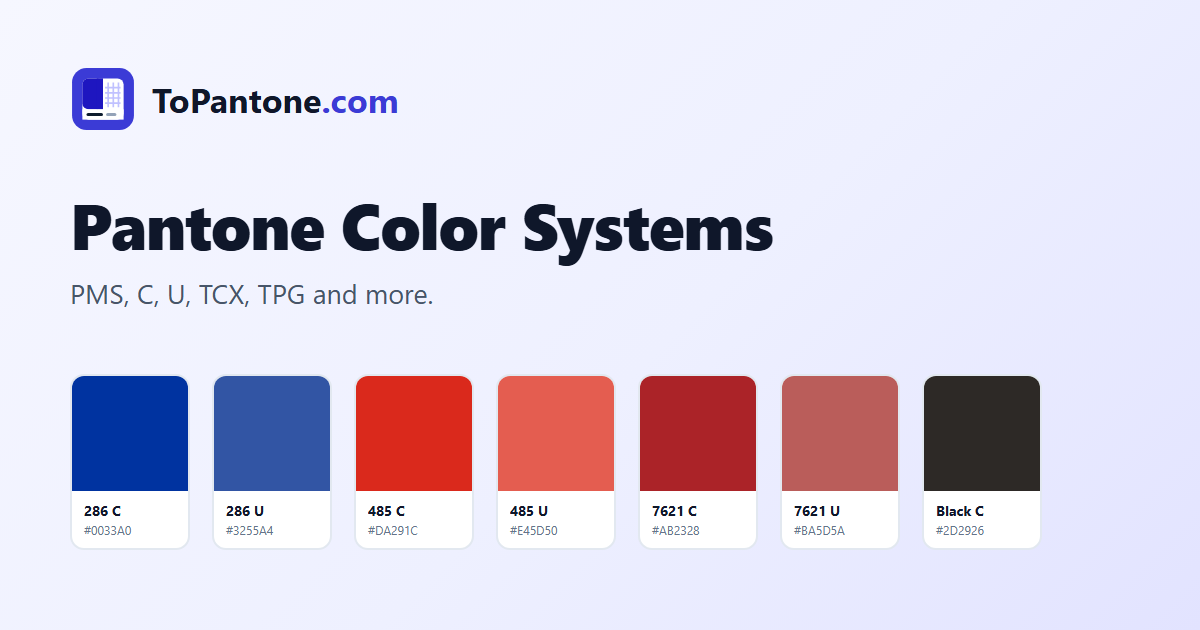
Pantone has 2 main color systems: the Pantone Matching System (PMS) for graphic design and print, with codes such as 286 C, and the Pantone Fashion, Home + Interiors (FHI) system for textiles and products, with codes such as 19-4052 TCX. The letters after the code tell you the system and the material the color was measured on. Using the wrong system is one of the most common reasons a “Pantone match” looks wrong.
The 2 main Pantone systems
| System | Used for | Code example | Suffixes |
|---|---|---|---|
| Pantone Matching System (PMS) | Print, packaging, logos, graphic design | 286 C | C, U |
| Pantone Fashion, Home + Interiors (FHI) | Clothing, textiles, home goods, paint | 19-4052 TCX | TCX, TPG, TN, TSX |
The 2 systems do not share numbers. Pantone 286 C and Pantone 19-4052 TCX are both blues, but they come from different libraries and are not interchangeable.
Pantone Matching System suffixes
C: coated
C means the color is shown on coated paper, which has a smooth, sealed surface. Ink sits on top of the coating, so colors look crisp and saturated. Use C for brochures, magazines, glossy packaging and most marketing print.
U: uncoated
U means the same ink on uncoated paper, which is porous like office paper or kraft board. The paper absorbs ink, so colors look lighter and less saturated. Use U for letterheads, envelopes, books and matte packaging.
C and U use the same ink, but they look different enough to need separate references. In our reference data, the median difference between a C color and its U version is 6.36 ΔE00, a clearly visible change. Read our guide to coated vs uncoated Pantone colors for examples.
Older suffixes you may still see
- M (matte): matte coated paper, retired by Pantone in 2010
- CP and UP: process (CMYK) simulations of Pantone colors in the older Color Bridge guides
- CV, CVC, CVU: “computer video” screen simulations from very old Adobe libraries
If a brand guide lists one of these, convert it to a current C or U color before you send files to a printer.
Pantone Fashion, Home + Interiors suffixes
FHI codes have 6 digits: 2 for lightness (11 to 19), 2 for hue and 2 for chroma. The suffix shows the material of the reference swatch:
| Suffix | Material | Use |
|---|---|---|
| TCX | Cotton | Apparel and textile dyeing |
| TPG | Paper (graphics) | Paper specs for products and interiors |
| TPX | Paper | Older paper version, replaced by TPG |
| TN | Nylon | Activewear and synthetic fabrics |
| TSX | Polyester | Polyester textiles |
The Pantone Color of the Year uses FHI codes; 2025’s Mocha Mousse is 17-1230. See the full list in our Pantone Color of the Year guide.
Specialty PMS libraries
The Pantone Matching System has 3 specialty groups within the C and U guides:
| Library | Numbers | What makes it special |
|---|---|---|
| Metallics | 871–877 and 8001–8965 | Metallic pigments that shine |
| Neons (fluorescent) | 801–814 | Fluorescent pigments that glow |
| Neon tints | 901–942 | Lighter tints of the neon colors |
| Pastels | 9020–9603 | Soft, light colors |
Metallic and neon inks cannot be shown accurately on any screen. Our guide to Pantone metallic and neon colors explains why.
Process and Extended Gamut guides
Pantone sells 2 guides that show how close process inks get to spot colors:
- Color Bridge: each Pantone solid color next to its closest CMYK build, with HEX and RGB values.
- Extended Gamut: colors built from CMYK plus orange, green and violet (CMYK + OGV), which reach about 90% of Pantone solid colors.
These guides help when a job must print in process color but still look close to the Pantone spot color.
Which system should you use?
Pick the system by what you are making:
- Use PMS C for glossy print, packaging and most brand guides.
- Use PMS U for matte stationery, books and uncoated board.
- Use FHI TCX for clothing and textile production.
- Use FHI TPG for paint, plastics and interior products specified on paper.
- Use HEX and RGB for websites and apps, converted from the PMS color.
If a client sends an FHI code but needs print, find a HEX value for the color and convert it with the HEX to Pantone converter to the nearest PMS color.
Frequently asked questions
What does C mean after a Pantone number?
C means coated. The color is shown on smooth, coated paper, where it looks brighter and more saturated than on uncoated paper.
Is Pantone TCX the same as PMS?
No. TCX belongs to the Pantone Fashion, Home + Interiors system for textiles, and PMS is for graphic print. The 2 systems use different numbers and different references.
Can I convert a TCX color to a PMS color?
Yes, as an approximation. Take the HEX or LAB value of the TCX color, then use a HEX to Pantone or LAB to Pantone converter to find the closest PMS color and check its ΔE00 score.
What does U mean in Pantone?
U means uncoated. It is the same ink as the C version, printed on porous, uncoated paper.
Is Pantone M still used?
No. Pantone retired the matte (M) reference in 2010. Use the coated (C) version for matte coated paper.
Summary
The letters after a Pantone code are not decoration: C and U belong to the Pantone Matching System for print, and TCX, TPG, TN and TSX belong to the Fashion, Home + Interiors system for products. Match the system to the material you are making, and convert between systems with HEX or LAB values when you must.
Convert your color to Pantone
Find the closest Pantone match for any HEX, RGB or CMYK value — free.