
Color science · · ToPantone Team
Pantone Cool Gray vs Warm Gray: Values, Differences and How to Choose
Compare all 11 Pantone Cool Gray and 11 Warm Gray colors with HEX and LAB values, see how they differ, and learn which gray suits your brand, plus the 8 Pantone blacks.
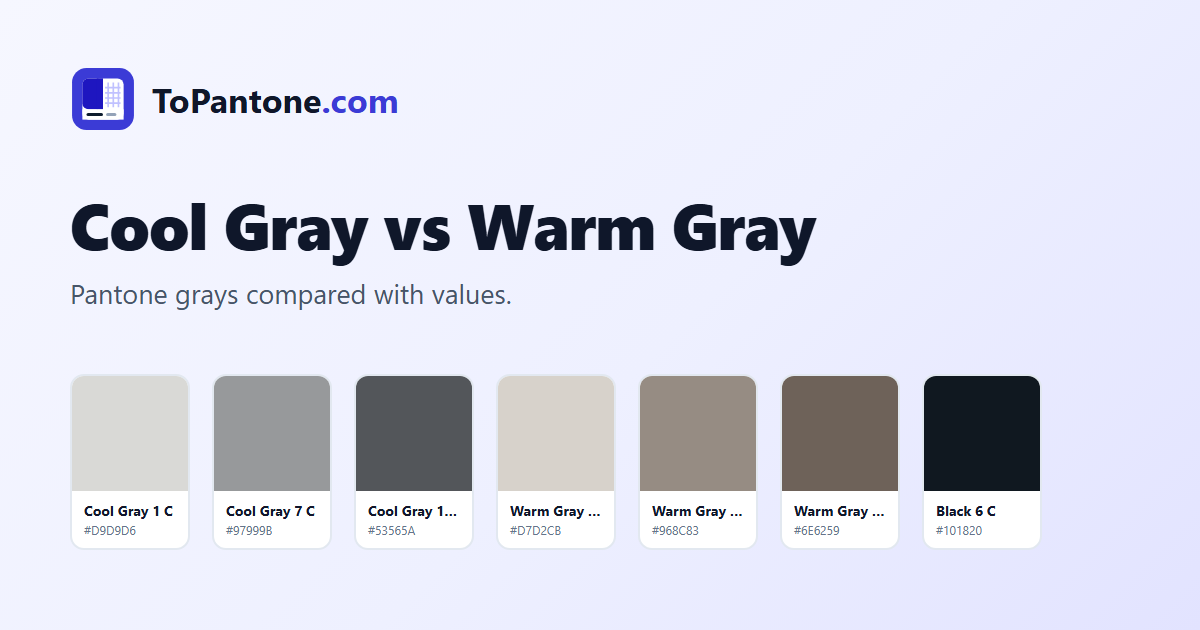
Pantone Cool Grays lean slightly blue, while Pantone Warm Grays lean red-yellow: at the same step, a Warm Gray has a b* value about 3 to 10 points higher, which reads as beige. Both sets run from 1 (lightest) to 11 (darkest). Cool Gray 7 C and Cool Gray 11 C are among the most used grays in corporate branding, while Warm Grays suit natural, food and lifestyle brands.
How to tell cool and warm grays apart
The difference shows in the b* value of CIELAB, the blue–yellow axis:
- Cool Grays have a b* between +1.5 and −2.7, so they sit at neutral or lean slightly blue.
- Warm Grays have a b* between +4.1 and +6.9, so they lean yellow, and their a* rises to +3.2, a touch of red.
Next to each other, a Cool Gray looks clean and technical, and a Warm Gray looks soft and earthy.
Pantone Cool Gray values
Values below are screen approximations from our reference data, with LAB under D65.
| Pantone | HEX | L* | a* | b* |
|---|---|---|---|---|
| Cool Gray 1 C | #D9D9D6 | 86.6 | −0.5 | 1.5 |
| Cool Gray 2 C | #D0D0CE | 83.4 | −0.4 | 1.0 |
| Cool Gray 3 C | #C8C9C7 | 80.8 | −0.7 | 0.9 |
| Cool Gray 4 C | #BBBCBC | 76.2 | −0.3 | −0.1 |
| Cool Gray 5 C | #B1B3B3 | 72.8 | −0.7 | −0.2 |
| Cool Gray 6 C | #A7A8AA | 68.8 | 0.0 | −1.2 |
| Cool Gray 7 C | #97999B | 63.1 | −0.3 | −1.3 |
| Cool Gray 8 C | #888B8D | 57.7 | −0.7 | −1.5 |
| Cool Gray 9 C | #75787B | 50.3 | −0.5 | −2.0 |
| Cool Gray 10 C | #63666A | 43.1 | −0.3 | −2.7 |
| Cool Gray 11 C | #53565A | 36.4 | −0.3 | −2.7 |
The darker Cool Grays turn bluer: b* drops from +1.5 at Cool Gray 1 to −2.7 at Cool Gray 11.
Pantone Warm Gray values
| Pantone | HEX | L* | a* | b* |
|---|---|---|---|---|
| Warm Gray 1 C | #D7D2CB | 84.4 | 0.5 | 4.1 |
| Warm Gray 2 C | #CBC4BC | 79.5 | 1.0 | 4.9 |
| Warm Gray 3 C | #BFB8AF | 75.1 | 0.9 | 5.4 |
| Warm Gray 4 C | #B6ADA5 | 71.2 | 1.8 | 5.3 |
| Warm Gray 5 C | #ACA39A | 67.5 | 1.7 | 5.8 |
| Warm Gray 6 C | #A59C94 | 64.9 | 1.8 | 5.4 |
| Warm Gray 7 C | #968C83 | 58.9 | 2.1 | 6.1 |
| Warm Gray 8 C | #8C8279 | 55.0 | 2.2 | 6.2 |
| Warm Gray 9 C | #83786F | 51.2 | 2.6 | 6.5 |
| Warm Gray 10 C | #796E65 | 47.2 | 2.7 | 6.6 |
| Warm Gray 11 C | #6E6259 | 42.4 | 3.2 | 6.9 |
The Warm Grays get warmer as they get darker: b* rises from 4.1 to 6.9 and a* from 0.5 to 3.2.
Same number, different lightness
The 2 sets do not step evenly against each other. Warm Gray 11 C (L* 42.4) is about as light as Cool Gray 10 C (L* 43.1), and Cool Gray 11 C (L* 36.4) is darker than any Warm Gray. If you swap a Cool Gray for a Warm Gray in a design, pick by lightness, not by number.
Which gray should you choose?
Choose a Cool Gray to:
- Pair with blues, greens and purples.
- Give technology, finance and healthcare brands a clean, modern look.
- Set body text and UI elements next to bright brand colors.
Choose a Warm Gray to:
- Pair with reds, oranges, browns and creams.
- Give food, hospitality, interiors and natural products a soft, welcoming look.
- Match kraft paper, wood and natural materials.
A practical test: put your main brand color next to Cool Gray 7 C and Warm Gray 7 C. The gray that makes the brand color look cleaner is usually the right one.
The 8 Pantone blacks
Pantone offers 8 blacks with different undertones:
| Pantone | HEX | Undertone |
|---|---|---|
| Black C | #2D2926 | Warm, slightly brown |
| Black 2 C | #332F21 | Olive |
| Black 3 C | #212721 | Green |
| Black 4 C | #31261D | Brown |
| Black 5 C | #3E2B2E | Red-purple |
| Black 6 C | #101820 | Blue, the darkest |
| Black 7 C | #3D3935 | Warm gray |
| Neutral Black C | #222223 | Neutral |
Pair cool grays with Black 6 C or Neutral Black C, and warm grays with Black C, Black 4 C or Black 7 C.
Grays on screen and in print
Grays are the hardest colors to keep neutral. A small shift in press balance or monitor calibration turns a gray pink, green or blue, and the eye notices it more on a gray than on a strong color. Use a Pantone gray as a spot ink for large flat areas, such as packaging panels, and check grays on a printed proof. Find the values of any gray in the Pantone to HEX or Pantone to CMYK converter.
Frequently asked questions
What is the difference between Cool Gray and Warm Gray?
Cool Grays lean slightly blue and Warm Grays lean yellow-red. In CIELAB, Warm Grays have a b* value about 3 to 10 points higher than Cool Grays of similar lightness.
What is the HEX code for Pantone Cool Gray 11 C?
Pantone Cool Gray 11 C is approximately #53565A on screen.
What is the HEX code for Pantone Cool Gray 7 C?
Pantone Cool Gray 7 C is approximately #97999B on screen.
Is Pantone Black C a true black?
No. Pantone Black C is a warm, slightly brown black, approximately #2D2926 on screen. Pantone Black 6 C is the darkest and coolest Pantone black.
Summary
Cool Grays lean blue and suit clean, technical brands; Warm Grays lean beige and suit natural, friendly brands. Choose by undertone first and lightness second, pair each with a matching black, and approve grays on a printed proof.
Convert your color to Pantone
Find the closest Pantone match for any HEX, RGB or CMYK value — free.