
Pantone basics · · ToPantone Team
What Is PMS Color? The Pantone Matching System Explained
What PMS means, how Pantone spot colors differ from CMYK, how to read a Pantone code and when to use a spot color in your print job.
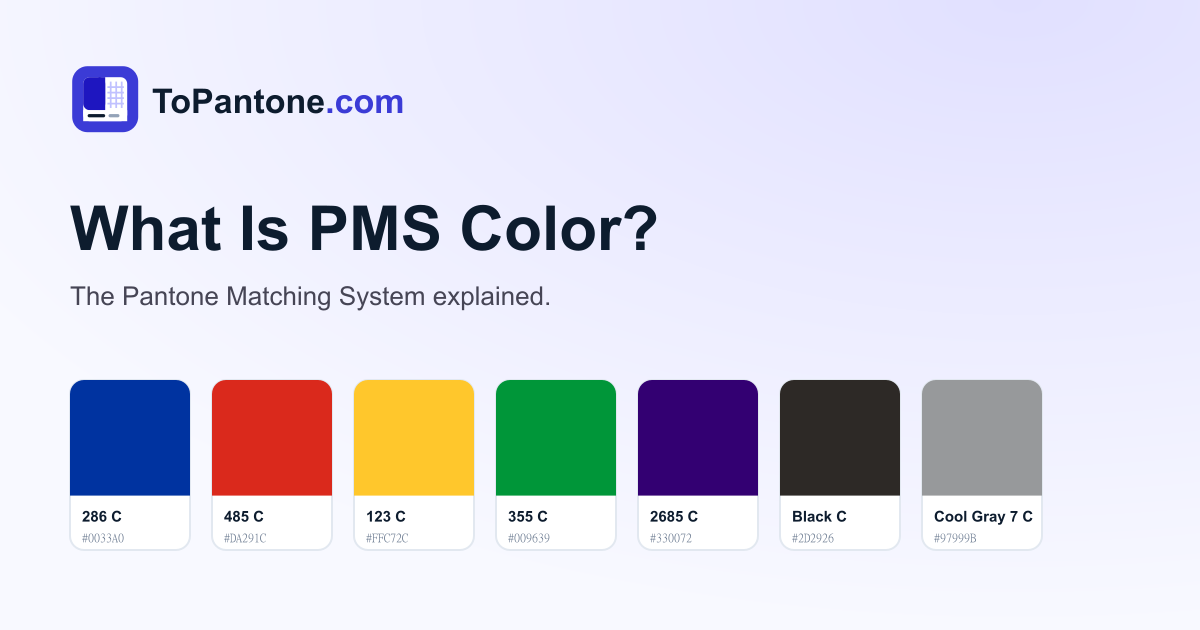
PMS stands for Pantone Matching System — a standardized library of spot colors that lets a designer in one country and a printer in another talk about exactly the same color. When someone says “PMS 286 C” or “Pantone 286 C”, they mean the same thing.
How PMS works
Instead of building a color on press from tiny dots of cyan, magenta, yellow and black (CMYK), every Pantone color has its own ink formula. The printer mixes the ink before the job, so the color is the same on every sheet and on every press that uses the same formula.
That is why brand colors, logos and packaging are so often specified as Pantone colors: a pre-mixed spot ink is far more consistent than a four-color build.
How to read a Pantone code
A typical code looks like PANTONE 2945 C:
- 2945 — the color number (some colors have names instead, such as Reflex Blue or Warm Red).
- C — the paper the color is shown on. C means coated (glossy) paper and U means uncoated paper.
The same ink formula is used for C and U, but it looks lighter and softer on uncoated stock. Read more in our guide to Pantone coated vs uncoated.
PMS vs CMYK
| PMS (spot color) | CMYK (process color) | |
|---|---|---|
| How it is printed | One pre-mixed ink per color | Four inks combined as dots |
| Consistency | Very high | Varies between presses |
| Best for | Logos, solid areas, 1–3 color jobs | Photos, full-color artwork |
| Bright & metallic colors | Possible | Limited gamut |
Many Pantone colors cannot be reproduced exactly in CMYK. If you need a four-color version, use our Pantone to CMYK converter and request a proof.
Finding the right PMS color
If you start from a digital color, the quickest way to find its Pantone equivalent is to convert it:
- From a web color: HEX to Pantone
- From screen values: RGB to Pantone
- From a print build: CMYK to Pantone
Each converter lists the closest Pantone matches with a ΔE (Delta E) score. A ΔE below 1 is practically invisible; up to about 2.5 is a close commercial match.
Key takeaways
- PMS and Pantone mean the same thing.
- Each PMS color is a pre-mixed spot ink with a fixed formula.
- C and U describe the paper, not a different ink.
- Always approve critical colors against a printed Pantone guide.
Convert your color to Pantone
Find the closest Pantone match for any HEX, RGB or CMYK value — free.